
Value Types vs Reference Types in C#
When learning C#, one of the most important distinctions to understand is between Value Types and Reference Types. This concept directly impacts memory allocation, performance, and application design.

🔹 What are Value Types?
Value types store data directly.
When you assign a value type variable to another, a copy of the value is created.
Stored in the stack memory.
Examples:
int,float,bool,char,struct,enum
Example in C#:
int x = 10;
int y = x;  // Copy created
y = 20;

Console.WriteLine(x); // 10
Console.WriteLine(y); // 20
✅ Here, x remains unaffected when y changes because they hold independent copies.
🔥 Ready to master ASP.NET MVC Architecture with real-world examples?
Grab my exclusive MVC Architecture eBook on Logic Lense now!
👉 Download Here
🔹 What are Reference Types?
Reference types store a reference (address) to the actual data.
When assigned, both variables point to the same memory location.
Stored in the heap memory (but the reference itself is on the stack).
Examples:
class,object,string,interface,delegate
Example in C#:
class Person
{
    public string Name;
}

Person p1 = new Person();
p1.Name = “Shreya”;

Person p2 = p1;  // Reference assigned
p2.Name = “Logic Lense”;

Console.WriteLine(p1.Name); // Logic Lense
Console.WriteLine(p2.Name); // Logic Lense
✅ Both p1 and p2 point to the same memory location, so changes affect both.
🔹 Key Differences (Table)
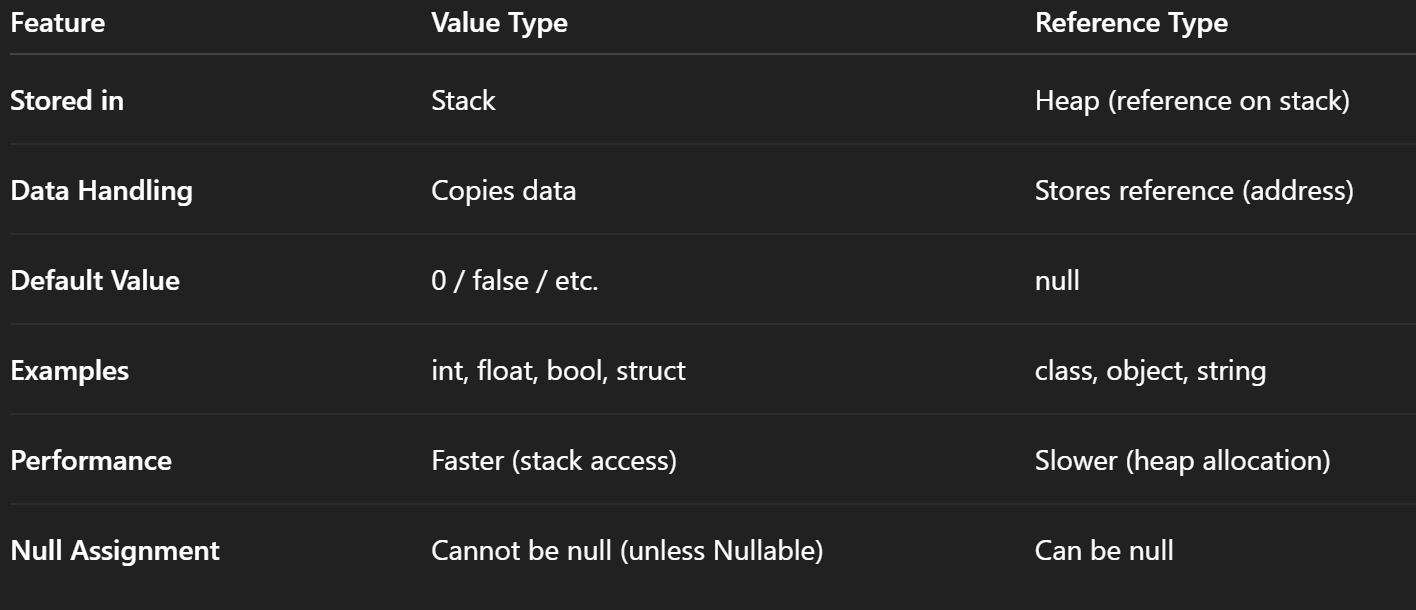
🔹 Best Practices
Use Value Types for small, short-lived data.
Use Reference Types for large objects or when you need shared access.
Always check for
nullin reference types to avoid exceptions.Consider
structfor lightweight objects;classfor complex behavior.
🔹 Interview Questions
What is the difference between value and reference types in C#?
Where are value types and reference types stored in memory?
Can a value type be
null?Why is
stringa reference type but behaves like a value type in some cases?What is the difference between
structandclass?
✅ Conclusion
Understanding the difference between Value Types and Reference Types helps you write more efficient, bug-free C# applications. This concept forms the foundation for memory management, performance tuning, and interview success.
🔥 Ready to master ASP.NET MVC Architecture with real-world examples?
Grab my exclusive MVC Architecture eBook on Logic Lense now!
👉 Download Here